Hash Runs
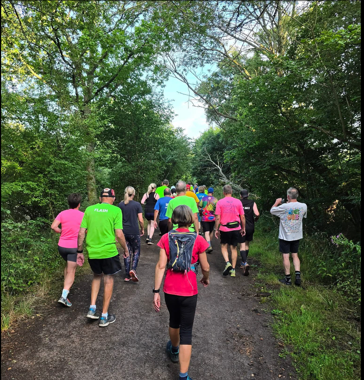
The weekly Brighton Hash starts from a different pub every week, occassinally starting from a place of interest or a member’s house. Most hashers will stay afterwards at the on-inn for refreshments (usually beer) and there will be food available to purchase but not everyone eats. The current run fee is £1 and the first run is free.
There are no rules on the Hash. The hash is intended to be fun, it’s a opportunity to meet people, run/walk a bit and maybe drink a beer. The following information is only a rough guideline, you should not rely too much on it.
Hash runs are normally 4-5 miles (6-8 km) long, set beforehand by a ‘hare’ (more on that below) and the pack must find/follow the trail. Faster runners will do more ‘checking’ (finding of the route) and ‘fish hooks’ (a loop back to prevent faster runners getting too far ahead). As such, faster runners will cover more distance. There will usually be a shorter walker’s route as well.
The Hash Horn is carried by a hasher (currently a hasher called ‘Rebel WHK’) to signal the trail, whilst other members will utilise verbal communication. The most common term is “On-On”, shouted by runners to let others know they are on the right trail. A yell of “R-U?” (pronounced “are you”) is a question to other hashers if they are on trail – it should be responded with either “On-On”, “Looking” or “Checking”, or “Checking On One”. Every Hash House Harrier group uses its own set of trail marks, and the names for these marks may vary widely, so newcomers or visitors will have the local markings explained to them before the run at a “chalk talk”.
The hare usually explains their markings at the start of the trail, as some marks like X or O may have different meanings depending on the local custom and may vary from hare to hare within the same kennel.
Typically the trail will be laid in flour or chalk, but other substances may be used too, e.g. sawdust or pieces of toilet paper. These methods of marking are biodegradable – permanent marks (e.g. paint, plastic tape) are NOT used.
Signals and Terms:
| Symbol | Description | Brighton Hash Meaning If rules differ, it may be explained during the pre-run “chalk talk.” |
| ↑ • | An arrow, spot, flour blob, or a piece of toilet roll |
One arrow, a flour blob, or hanging toilet roll indicates the trail could continue in this direction – unless it is a False trail. A second arrow, blob, or toilet roll on the same trail indicates that one is on the True Trail. |
| ↑↑ | Two arrows |
True trail. The trail definitely continues in this direction. Sometimes added by the Hare to reassure the pack after checks or on confusing trails. |
| ✕, ⊗, F ↓ | An X, ⊗, F, arrow pointing backward | False trail: Go back to the most recent Check and look for True Trail in a different direction. The pack will have to find where it continues. Often, the Hare may have laid multiple false trails to confuse the pack. To find the True Trail, typically the pack must find two marks in a row. It is customary to shout “on-one,” “on-on” when discovering each respective mark. |
| ◯ | An open circle (sometimes with Arrows giving options) or two pieces of toilet paper together | A Check. Found when the trail could go in different directions. Individual runners need to follow these different trails until they find the right trail (Two arrows, two flour blobs or two separate pieces of toilet roll). |
↷7 | A ‘hook’ mark with a number | A “Fish Hook.” The first runners, to the number in the hook, are to go back to the rear of the pack (often the ‘sweep’, i.e. a hasher assigned to follow the pack to make sure that no one is left behind) before proceeding. If the number is 7 then 7 runners go back (but this may exclude the elder hashers, i.e. those over 75) |
| ↖︎↗︎ | Two or more unmarked arrows pointing in different directions or one arrow and a question mark | Whichy-Way. One of the arrows is true, the other is false. One mark will indicate true trail as it is usually the first mark after a check. |
| RG, HH | Re-Group or Hash Hold. A mark that tells the pack to stop and wait for others to catch up. | |
| SS , BS, SIP | Sip Stop or Beer Stop can indicate a place on trail where the pack will consume some kind of beverage and possibly snacks. | |
| On Inn | A mark that tells the pack the pub is very close, usually within ¼ mile or 400 metres of the end of the trail, i.e. the “Inn”. |